
MathsSpot Guide 2026 explores how students can use online mathematics resources to improve their calculation skills, understand difficult concepts, and develop confidence in solving problems. Whether you are learning basic arithmetic, practicing algebra, exploring geometry, or preparing for examinations, a structured approach to mathematics can make studying more effective. This guide explains the features to look for in a math-learning website, useful study techniques, digital learning tools, and practical ways to build stronger mathematical foundations.
| Quick Information | Details |
|---|---|
| Topic | MathsSpot Guide 2026 |
| Category | Mathematics education |
| Main audience | Students, teachers, parents, and independent learners |
| Learning areas | Arithmetic, algebra, geometry, statistics, and problem-solving |
| Learning format | Online resources and independent practice |
| Main objective | Improve mathematical understanding and confidence |
| Suitable level | Depends on the resources and activities available |
1. What Is MathsSpot Guide 2026?
MathsSpot Guide 2026 is a useful topic for readers exploring online mathematics education and digital study resources. A guide of this kind can help learners understand how to organize their practice, identify suitable learning materials, and approach mathematical problems systematically. Before using any website associated with the MathsSpot name, check its current content, accessibility, and available educational features. This helps ensure that the materials match your learning needs rather than relying on assumptions about specific tools or services.
2. Why Online Mathematics Learning Matters
Online mathematics learning gives students additional opportunities to review lessons outside the classroom. Digital resources can make it easier to revisit explanations, practice calculations, and study at a convenient pace. Learners can focus on difficult subjects without feeling pressured to move forward before understanding the basics. However, online study works best when combined with active problem-solving, written calculations, and regular revision. MathsSpot Guide 2026 encourages readers to approach digital resources as learning aids rather than replacements for consistent effort and careful mathematical reasoning.
3. Main Goals of a MathsSpot Guide 2026
A good mathematics guide should make learning organized, understandable, and measurable. It should help students recognize their current skill level, choose suitable topics, and practice increasingly challenging problems. Clear explanations can reduce confusion, while worked examples demonstrate how mathematical rules apply in real situations. Learners should also develop the ability to explain why an answer is correct. These goals make a structured study guide valuable for beginners and more experienced students who want to strengthen their existing knowledge.
4. Understanding Basic Arithmetic

Arithmetic provides the foundation for many advanced mathematical topics. Students should become comfortable with addition, subtraction, multiplication, division, fractions, decimals, percentages, and negative numbers. A weak understanding of these concepts can make algebra and other subjects more difficult. Regular practice with short exercises helps learners improve speed and accuracy. When mistakes occur, reviewing each calculation is more useful than simply repeating the answer. A strong arithmetic foundation allows students to approach more complicated problems with greater confidence.
5. Introduction to Algebra of MathsSpot Guide 2026
Algebra introduces letters and symbols that represent unknown numbers. It allows students to describe mathematical relationships and solve problems using equations. For example, the equation \(x+5=12\) can be solved by subtracting five from both sides, giving \(x=7\). Understanding these basic steps prepares learners for more advanced topics, including linear equations, inequalities, expressions, and functions. Students should practice identifying variables, simplifying expressions, and checking answers. Writing each step clearly can prevent errors and make algebra easier to understand over time.
6. Exploring Geometry and Shapes
Geometry focuses on shapes, angles, lines, distances, areas, and volumes. It helps students understand the mathematical properties of objects in the world around them. Beginners can start by identifying triangles, circles, rectangles, and squares before moving on to perimeter and area calculations. More advanced learners can explore coordinate geometry, transformations, and three-dimensional figures. Drawing diagrams is particularly helpful because visual representations make relationships easier to recognize. Consistent practice with geometric formulas also helps students understand when and how to apply them.
7. Fractions, Decimals, and Percentages
Fractions, decimals, and percentages represent quantities in different ways. Learning how to convert between them is useful for school mathematics and everyday situations. For instance, one-half is equivalent to 0.5 and 50 percent. Students should practice comparing fractions, finding common denominators, converting decimals, and calculating percentage increases or decreases. These skills are useful when interpreting prices, discounts, measurements, and statistics. A structured learning guide can help learners understand the relationship between these representations instead of memorizing conversion rules without understanding their meaning.
8. Developing Logical Thinking of MathsSpot Guide 2026
Mathematics requires more than remembering formulas. It also involves recognizing patterns, evaluating information, and deciding which steps can lead to a correct answer. Logic puzzles and number sequences can help students develop these abilities. For example, identifying the next number in a sequence encourages learners to search for a consistent rule. Students should explain their reasoning rather than guessing. This approach helps build transferable problem-solving skills that can support science, technology, programming, and other subjects where careful analysis is important.
9. Interactive Games and Digital Activities
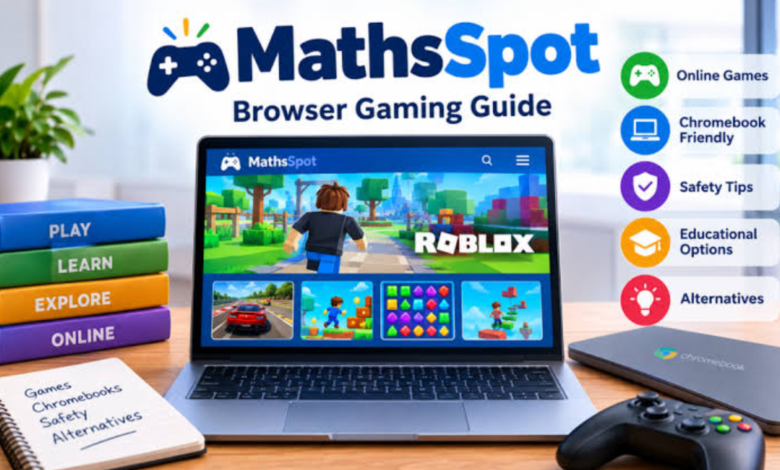
Interactive games can make mathematics practice more engaging by introducing challenges, rewards, and immediate feedback. Number puzzles, arithmetic quizzes, and educational obstacle courses are examples of activities that combine entertainment with problem-solving. However, readers should distinguish between websites that provide mathematics education and services associated with browser gaming. Online descriptions connect Maths Spot Guide 2026 browser-based gaming and Roblox, but they do not consistently establish that it offers a dedicated mathematics curriculum.
10. Understanding the Connection With Roblox
Roblox is an online platform where users can explore experiences created by developers and other community members. MathsSpot is a separate name that appears in searches related to Roblox and browser-based gaming. These terms should not be treated as interchangeable. Some online descriptions also associate MathsSpot-related searches with math puzzles and educational games, but that does not prove that every related website offers those activities. Understanding this distinction helps readers evaluate claims, recognize unofficial services, and choose the appropriate platform for gaming or educational purposes.
11. Browser-Based Gaming Explained of MathsSpot Guide 2026
Browser-based gaming allows users to access certain games through a web browser rather than installing a conventional application. Depending on the service, the game may run locally or rely on remote computing and streaming. This approach can be convenient for people using devices with limited storage or restricted installation permissions. Nevertheless, performance depends on the technology being used, browser compatibility, and internet quality. Users should also check the service’s identity and terms before using it. Not every browser gaming website offers the same features, security protections, or supported games.
12. Using a Chromebook Responsibly
Chromebooks are commonly used for education because schools can manage applications, accounts, and website access centrally. Browser-based services may be accessible without installing a desktop program, but school restrictions still apply. Students should respect their institution’s acceptable-use policies and avoid attempting to bypass administrative controls. If a website is blocked, asking a teacher or administrator is the appropriate solution when access is needed for a legitimate activity. For personal entertainment, users should choose permitted devices and networks while keeping their accounts and personal information secure.
13. Internet Speed and Performance
A stable internet connection is important for online learning and browser gaming. Educational videos may buffer when a connection is slow, while cloud gaming can experience delayed controls or reduced image quality. Closing unnecessary browser tabs, using a reliable network, and keeping the browser updated may improve the experience. Users should also remember that network congestion can affect performance even when a device is working correctly. If a service repeatedly fails to load, check the connection and official support information rather than downloading unfamiliar software suggested by pop-ups.
14. Choosing Reliable Online Resources
Choosing an online resource begins with identifying its purpose. A mathematics website should provide relevant explanations, accurate examples, and exercises suited to the learner’s level. A gaming website should be evaluated for security, transparency, and appropriate content. Read available privacy policies and check whether the operator provides clear information about the service. Be cautious when a website makes broad claims without evidence. Comparing resources can help students and parents distinguish educational materials from entertainment platforms and avoid relying on misleading descriptions.
15. Building a Consistent Study Routine
A regular study routine can help learners make steady progress. Instead of attempting to complete every topic in one session, divide the material into manageable sections. Spend time reviewing previous lessons, practicing new concepts, and correcting mistakes. Short, focused sessions may be easier to maintain than occasional long study periods. Students can also keep a notebook of difficult questions and review them at the end of each week. Tracking progress makes it easier to identify weaknesses and decide which topics need additional attention.
16. Learning Through Practice Questions of MathsSpot Guide 2026
Practice questions allow students to apply what they have learned and identify areas that need improvement. Begin with straightforward examples before moving to more challenging problems. After completing an exercise, check the answer and review the method used. If an answer is incorrect, identify the exact step where the mistake occurred. This is more effective than simply memorizing the correct result. Combining written exercises with suitable digital quizzes can provide variety while helping learners develop accuracy, patience, and confidence.
17. Common Mathematics Learning Mistakes
Students sometimes try to memorize formulas without understanding the concepts behind them. Others rush through calculations, skip intermediate steps, or avoid reviewing incorrect answers. These habits can create difficulties when questions become more complex. A better approach is to understand why a formula works, write calculations clearly, and check whether the answer makes sense. Learners should also avoid comparing their progress with others. Different students need different amounts of practice, and steady improvement is more valuable than trying to master every topic immediately.
18. Benefits for Parents and Teachers
Parents and teachers can support mathematics learning by encouraging curiosity and consistent practice. They can help students select age-appropriate resources, explain difficult concepts, and establish realistic study goals. Asking a learner to describe how an answer was reached can reveal whether the concept is understood. Adults should also review the privacy and suitability of online platforms before recommending them. A website’s popularity does not guarantee educational value, so learning objectives should guide resource selection rather than appearance, advertising, or entertainment features.
19. Digital Safety and Privacy
Online safety matters whenever students visit unfamiliar websites. Users should avoid sharing private information unnecessarily, downloading unknown files, or entering account credentials on suspicious pages. Check the domain carefully because imitation websites can resemble familiar services. Browser notifications and unexpected redirects should be treated cautiously. Parents can discuss safe browsing habits with younger users, while schools can provide guidance on approved websites. When a platform’s ownership or data practices are unclear, choosing a better-documented alternative is a sensible way to reduce unnecessary risk.
20. Evaluating Website Features

Before relying on an online platform, examine what it actually provides. Useful evaluation criteria include ease of navigation, clear instructions, accessibility, current content, and appropriate security information. For mathematics education, check whether explanations are accurate and whether exercises match your curriculum. For browser gaming, examine available games, device requirements, and the service’s terms. Do not assume that a name containing the word “math” guarantees academic resources. Confirming the purpose of a website helps users make informed decisions and avoid unrealistic expectations.
21. Alternatives for Mathematics Education
Students who need structured mathematics instruction can explore school-approved learning platforms, textbooks, teacher-created worksheets, and established educational websites. Look for resources that explain concepts step by step and provide opportunities for independent practice. Video lessons can help clarify unfamiliar topics, while written exercises encourage learners to apply the methods themselves. Interactive activities can provide variety, but they should complement a coherent study plan. The most suitable resource is one that matches the learner’s level, curriculum, accessibility needs, and learning objectives.
22. How to Measure Learning Progress
Progress should be measured through understanding and accuracy rather than time spent on a website alone. Students can record practice scores, note recurring mistakes, and periodically retry earlier questions. Improving results across several sessions can indicate that a concept is becoming more familiar. However, a single high score does not necessarily demonstrate complete understanding. Learners should also solve questions without assistance and explain their methods. Regular review makes it easier to identify knowledge gaps and adjust the study plan when necessary.
23. The Future of Online Learning in 2026
Digital learning continues to offer new ways to access explanations, practice activities, and educational support. Interactive exercises, mobile-friendly resources, and personalized study recommendations can make learning more flexible. At the same time, users need to consider accuracy, privacy, accessibility, and the quality of the material. Technology is most useful when it supports clear educational goals. In 2026, students can benefit from combining trusted digital resources with teacher guidance, independent practice, and traditional study methods instead of relying on a single website.
24. Is MathsSpot Suitable for Everyone?
The suitability of MathsSpot depends on what someone expects from it. People searching for browser gaming may be interested in its reported connection with Roblox-related access. Students seeking structured mathematics lessons should first verify whether the specific resource they find actually provides teaching materials and exercises. The available descriptions do not consistently confirm a dedicated mathematics curriculum. Parents and educators should assess the site’s content, security, and suitability before recommending it. Choosing a resource according to its verified purpose helps prevent confusion and supports better decisions.
25. Final Thoughts on MathsSpot Guide 2026
MathsSpot Guide 2026 highlights the importance of understanding online platforms before using them for learning or entertainment. The name is associated with browser gaming, Roblox-related searches, and Chromebook access, while claims about dedicated mathematics instruction require careful verification. Students who want to improve their math skills should prioritize accurate explanations, regular exercises, and consistent review. Those interested in browser gaming should pay attention to privacy, login security, and school or workplace policies. A thoughtful approach to digital resources can help users make safer and more productive choices.
Frequently Asked Questions
- What is MathsSpot Guide 2026? – Answer: It is a guide to understanding the MathsSpot name, its reported browser-gaming connections, and considerations for online use.
- Is MathsSpot an official mathematics learning platform? – Answer: Its name sounds educational, but available descriptions mainly associate it with browser gaming and Roblox-related searches.
- Can MathsSpot be used on a Chromebook? – Answer: Browser-based access may be possible, depending on compatibility, network conditions, and device restrictions.
- Is MathsSpot safe to use? – Answer: Its safety cannot be guaranteed; users should check the website address, avoid suspicious downloads, and protect account information.
- What is the best way to improve mathematics skills online? – Answer: Use reliable educational resources, practice regularly, review mistakes, and follow a structured study plan.