
1. Introduction to the Website
The internet provides countless websites where people can explore entertainment, technology, lifestyle, and general-interest information. Understanding a website’s purpose helps readers decide whether its content matches their needs. Almawadahit.com has attracted attention from people looking for information about its identity, content categories, and overall usefulness. Its online presentation combines a technology-related tagline with a wider range of informational articles. This guide explores the website’s visible features, possible benefits, and limitations while explaining how visitors can evaluate online information carefully.
| Website Detail | Information |
|---|---|
| Website name | Almawadahit.com |
| Website type | Online article publication |
| Tagline | Tech and Trends |
| Main visible topics | Celebrity homes, net worth, cars, and lifestyle |
| Publishing platform | Reported as WordPress |
| Main purpose | Reading informational articles |
| Ownership | Not independently confirmed |
| Official website | Visit the website |
2. What Is Almawadahit.com?
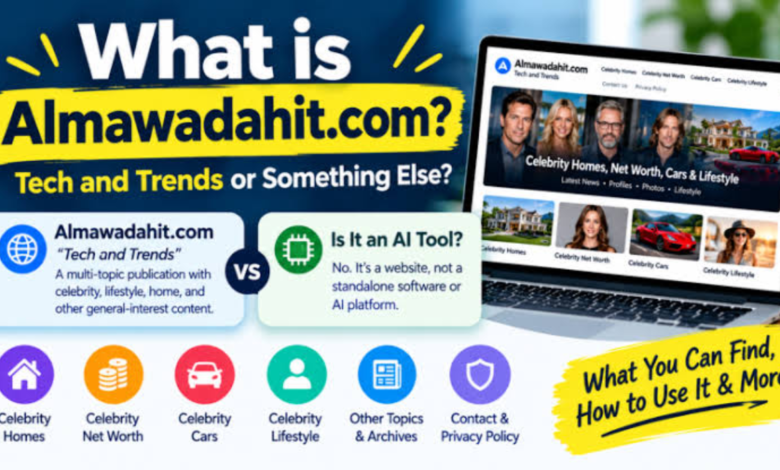
Almawadahit.com is an online publication where visitors can browse articles covering general-interest subjects. The website’s public presentation uses the phrase “Tech and Trends,” although its prominent categories include celebrity homes, celebrity net worth, celebrity cars, and celebrity lifestyle. This makes it more appropriate to describe the website as an informational blog than as a dedicated software application. Readers interested in online articles can explore its published material and decide which subjects are relevant to their interests.
3. Purpose and Main Objectives

The main purpose of an informational website is to make material accessible to readers through organized articles and topic categories. A publication can help visitors discover background information, learn unfamiliar terminology, and explore subjects they might otherwise need to research across multiple sources. Almawadahit.com appears to follow this general publishing approach. However, readers should distinguish between the website’s presentation and independently verified facts about its operations. Its precise editorial objectives, business structure, and long-term plans should not be assumed without clear statements from the publisher.
4. Types of Content Available
The visible categories provide a useful starting point for understanding the website. Celebrity-related topics occupy a prominent place in its public presentation, particularly articles about properties, financial estimates, vehicles, and personal lifestyles. Other descriptions associate the website with technology and broader informational subjects. The exact mix of published material may change as new articles are added or older pages are updated. Visitors should examine the current category pages rather than assume that every topic mentioned in third-party reviews receives equal attention.
5. Technology and Digital Trends
Technology-related content can help readers understand developments in software, artificial intelligence, digital services, and everyday internet use. Websites covering these subjects may introduce new terminology and explain how particular tools work. The “Tech and Trends” tagline suggests a technology-oriented identity, but branding alone does not establish that a website develops its own software or artificial intelligence products. Visitors looking for technical guidance should check the specific article, publication date, supporting evidence, and relevant official documentation before acting on its recommendations.
6. Celebrity and Entertainment Articles
Celebrity articles are popular because readers often want background information about actors, television personalities, journalists, athletes, and other public figures. Stories about professional achievements, homes, cars, and lifestyles can provide an accessible introduction to familiar personalities. The website’s visible categories indicate that this type of content is important to its current presentation. Nevertheless, personal details and financial estimates deserve careful evaluation. Readers should distinguish between confirmed public information, reasonable estimates, and speculation, especially when an article discusses private relationships or a person’s wealth.
7. Website Design and Navigation
A useful publishing website should make it straightforward to move between its homepage, categories, individual articles, and contact information. Search functionality can also help visitors find a particular topic without browsing every page manually. Public descriptions of Almawadahit.com report a magazine-style layout with article listings, category navigation, and a search feature. Such features are common across online publications and can make browsing more convenient. Actual usability, loading performance, and mobile compatibility should be assessed by visiting the website on the device and browser a reader normally uses.
8. User Experience and Accessibility
User experience involves how comfortably people can read, navigate, and understand a website. Clear typography, meaningful headings, descriptive links, and a consistent layout help visitors locate information efficiently. Accessibility is equally important because readers may use screen readers, keyboard navigation, magnification, or mobile devices. A website’s actual accessibility cannot be established merely from its appearance. Visitors can assess whether text is readable, links are understandable, and important information remains accessible on different screen sizes. These qualities are useful indicators when deciding whether to return to an online publication.
9. Information for General Readers
General-interest websites can appeal to people with different backgrounds and levels of knowledge. A reader might visit to learn about a public figure, explore an unfamiliar subject, or find an introductory explanation before conducting more detailed research. This broad approach can be convenient when articles use straightforward language and explain unfamiliar concepts. However, introductory information should not automatically be treated as expert advice. Readers researching complex technical, legal, medical, or financial questions should seek reliable specialist sources and use general articles as a starting point rather than their only source.
10. Benefits of Informational Websites
Online publications provide several practical advantages. They allow readers to explore information at different times, revisit useful pages, and compare explanations of the same subject. Articles can also introduce readers to questions they had not previously considered. When a publication organizes its material clearly, it becomes easier to identify relevant topics and continue learning independently. These benefits depend on the quality of the material being published. Accurate explanations, transparent sourcing, clear authorship, and appropriate updates are more valuable than a large collection of articles that simply repeat familiar information.
11. How to Find Useful Articles
Visitors can make their browsing more productive by starting with a clear question. They should identify the relevant category, use the site’s search feature if available, and read the article’s introduction before deciding whether it addresses their needs. Checking the publication date can help determine whether the information is likely to remain current. For detailed questions, readers should also look for cited documents, official statements, and links to original sources. A few minutes spent evaluating relevance and evidence can prevent confusion and reduce dependence on unsupported claims.
12. Evaluating Content Accuracy
Content accuracy is an important consideration for every online publication. A well-written article can still contain outdated statistics, incorrect dates, or claims that lack evidence. Readers should check whether important statements are supported by reputable sources and whether those sources actually say what the article claims. Celebrity profiles require particular care because estimated wealth, property values, and personal details may be repeated across websites without independent confirmation. Comparing information against official interviews, public records, or established reporting helps readers develop a more balanced understanding of a topic.
13. Privacy and Online Safety
Online safety matters whenever someone visits an unfamiliar website. Readers should use a current browser, keep security software updated, and avoid downloading unknown files or installing extensions prompted by unfamiliar pages. They should also be cautious about unexpected redirects, misleading advertisements, and requests for unnecessary personal information. A website’s privacy policy can explain what information its publisher says it collects and how it may be used. Reading that policy is helpful, but it does not independently verify actual data-handling practices. HTTPS is also useful, although it does not guarantee that every claim or activity on a website is trustworthy.
14. Understanding Website Ownership
Knowing who publishes a website can help readers assess accountability and editorial transparency. Useful indicators include a named publisher, author biographies, an about page, contact details, and a clear process for correcting mistakes. Publicly available descriptions of Almawadahit.com do not establish a fully verified ownership structure. Therefore, readers should avoid assuming the identity of its founder or the company behind it without stronger evidence. A generic author name or contact email can facilitate communication, but neither independently proves the legal identity, professional qualifications, or location of the operator.
15. Differences Between Similar Domains
One important step when researching a website is checking its complete web address. Similar names can belong to unrelated publishers, organizations, or businesses. For example, almawadahit.com and almawadahittech.com are different domains, and their similar wording does not prove that they share an owner. A separate address such as almawadahit.ae should also be evaluated independently. Visitors should confirm the domain shown in their browser before sharing information, following advice, or attributing statements to a particular organization. This simple precaution helps prevent mistaken identity and confusion between similarly named websites.
16. Search Engine Visibility
Search engines help users discover articles by matching pages with their queries. Informational publishers may improve discoverability by using descriptive page titles, relevant keywords, logical navigation, and content that directly answers readers’ questions. However, appearing in search results is not proof of accuracy or authority. Search ranking systems can surface pages with varying levels of editorial quality. When an article appears prominently, readers should still evaluate its evidence, publication date, and author information. Search visibility is most useful when combined with careful judgment and verification from reliable independent sources.
17. Content Quality and Readability
High-quality content should provide meaningful information rather than merely repeat a keyword. Strong articles answer the reader’s main question early, organize supporting details logically, and explain unfamiliar concepts in accessible language. They also distinguish established facts from estimates and clearly identify information that remains uncertain. Good editing improves grammar, removes repetition, and makes the reading experience more enjoyable. Readers evaluating an article should ask whether it contributes useful details, supports its central claims, and answers the question promised by its title. These principles apply equally to technology guides and celebrity profiles.
18. Responsible Use of Online Information

Online information is most useful when readers consider its source and context. A single article may provide a helpful overview, but important decisions should not depend on an unverified statement. When researching a person’s background, for example, readers can compare published biographies with interviews or other primary sources. When learning about technology, they can consult official documentation and reputable specialist publications. This approach reduces the chance of repeating inaccurate claims. It also encourages responsible sharing, particularly when information concerns another person’s finances, reputation, private life, or professional history.
19. Advantages for Everyday Browsing
A multi-topic publication may suit readers who prefer exploring different subjects in one place. Instead of visiting a narrowly focused site for every question, they can browse categories and discover related articles. This format can be convenient for casual learning, entertainment, and preliminary research. Its value depends on how effectively the articles serve their intended audience. Readers should consider whether the information is relevant, easy to understand, and supported by adequate evidence. If a page provides only broad statements without meaningful details, a more specialized publication may offer a better answer.
20. Limitations Readers Should Consider
Every informational website has limitations, and readers should understand them before relying on published material. A broad subject range does not guarantee deep expertise across every category. Some articles may be introductory, while others may contain estimates or details that change over time. Publicly available information may also leave questions about authorship, sourcing, and ownership unanswered. These uncertainties do not automatically establish that a website is fraudulent or that its articles are false. They simply mean that visitors should evaluate individual pages carefully and seek stronger evidence when accuracy is important.
21. Tips for First-Time Visitors
First-time visitors can begin by reviewing the homepage and selecting a topic that matches their interests. They should read the introduction, check the publication date, and look for author information or supporting references. Before sharing personal information, they should review the privacy policy and determine whether the request is necessary. If an article makes a surprising claim, checking it against an independent source is a sensible next step. Readers should also verify that links lead to the intended destinations and avoid entering sensitive information into unfamiliar forms without a clear reason.
22. The Future of Digital Publishing
Digital publishing continues to evolve as search technology, mobile browsing, artificial intelligence, and changing reader expectations influence how information is produced and consumed. Online publications can remain useful by prioritizing original research, transparent sourcing, accessible design, and timely corrections. Readers increasingly benefit when articles clearly explain how conclusions were reached and which details remain uncertain. For any general-interest website, long-term credibility depends on providing genuine value rather than relying only on search traffic. Clear editorial standards and a consistent commitment to accuracy can help a publication build stronger relationships with its audience.
23. How to Decide Whether the Website Is Useful
The best way to evaluate a publication is to compare its content with your own needs. If you want an introductory overview of a celebrity, lifestyle topic, or digital trend, an informational blog may provide a convenient starting point. If you need verified figures, specialist guidance, or information for an important decision, look for primary sources and established expert publications. Check whether the article provides evidence and whether its claims can be independently confirmed. This practical approach helps you decide when a page is useful and when further research is necessary.
24. Final Thoughts on Almawadahit.com
Overall, Almawadahit.com can be approached as an article-based online publication whose visible presentation combines a technology-related tagline with celebrity and lifestyle content. Its usefulness depends on the relevance, clarity, and reliability of the individual articles readers choose to explore. Before relying on a claim, check its source, date, author, and supporting evidence. Do not assume that similarly named domains share ownership or that a search ranking guarantees credibility. For broader background on how websites and online publishing work, readers can consult the related World Wide Web article on Wikipedia. This provides additional context for understanding the internet and the role websites play in sharing information.
Frequently Asked Questions
1. What is Almawadahit.com?
– It is an online publication with a technology-related tagline and visible categories covering celebrity homes, net worth, cars, and lifestyle.
2. Is Almawadahit.com an AI tool?
– The available website descriptions identify it primarily as an article-based publication, not a verified standalone AI application.
3. Who owns Almawadahit.com?
– Its ownership has not been independently confirmed in the public descriptions reviewed.
4. Is Almawadahit.com safe to visit?
– Use ordinary online safety precautions, review its privacy policy, avoid suspicious downloads, and do not assume that HTTPS guarantees trustworthy content.
5. Can readers trust every article on Almawadahit.com?
– Readers should evaluate each article individually and verify important claims through official documents, primary sources, and reputable independent publications.